Recover control
Governance reset, verified membership, ratified constitution, asset register, and dual-signatory banking.
Gate: All minimum viable CPA outputs independently verified.
Land Programme
A structured pilot programme designed to help Community Property Associations recover governance, stabilise land use, professionalise operations, and move toward responsible commercialisation.
The problem
The problem is systemic. It affects governance, land use, asset management, and commercial activity. Land that should be a productive livelihood asset is too often ungoverned, overgrazed, and financially opaque. GAD Foundation’s CPA Recovery & Land Productivity Framework offers a rigorously sequenced, funding-ready solution built for accountability, field reality, and long-term recovery.
The 4-step ladder
The framework respects the real condition of each CPA and unlocks larger investments only when independently verified milestones have been met.
Governance reset, verified membership, ratified constitution, asset register, and dual-signatory banking.
Gate: All minimum viable CPA outputs independently verified.
Carrying capacity baseline, grazing camps, reduced stocking pressure, and erosion hotspots stabilised.
Gate: Stocking rate brought within sustainable carrying limits.
Digital MIS, formalised leases, active rent collection, and timely statutory compliance.
Gate: Formal lease and financial control thresholds achieved.
Separate operating entity, enterprise plan, operator partnership, benefit-sharing policy, and market linkages.
Gate: Productive revenue and documented member benefit confirmed.
System logic
Our strategy is not based on loose activity. It is based on a staged system that moves communities and opportunities from self-assessment and verification through readiness, activation, and qualified partnership.
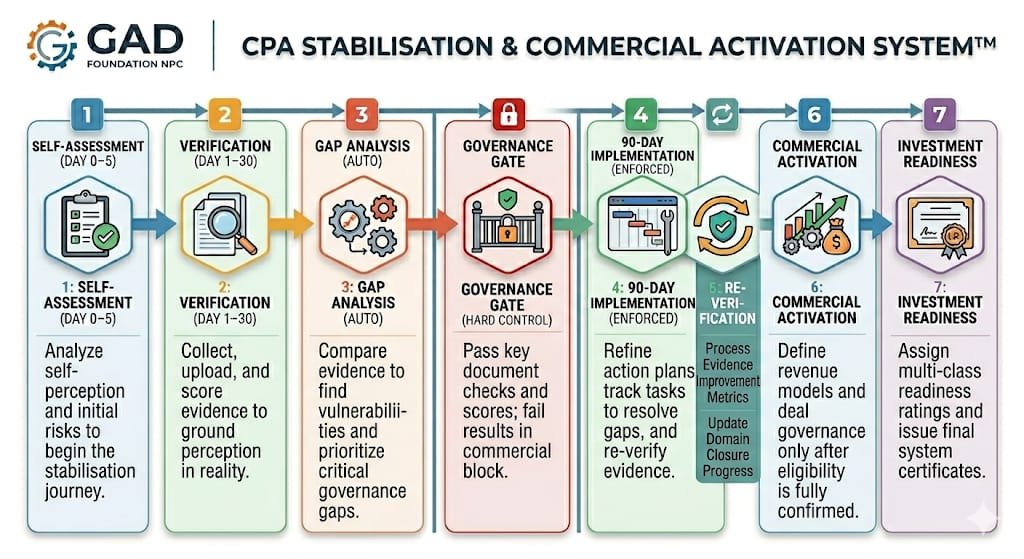
Publicly, this system shows the discipline of our approach: assess, verify, address governance gaps, implement improvements, and only then proceed toward activation and readiness. It demonstrates seriousness without exposing confidential partner terms, controls, or internal commercial detail.
Why this structure matters
CPAs that are not ready remain at lower-cost facilitation support until governance is stabilised. This protects resources, avoids false acceleration, and gives communities clear visibility into what must be achieved to unlock the next level.
The framework blocks the common mistake of trying to commercialise before institutional control is established.
Higher-value funding follows verified proof rather than assumption, pressure, or political optimism.
Communities, funders, and partners can all see clearly how progress is measured and what unlocks the next stage.
GAD 6-Point Nexus
The framework is anchored to the GAD Nexus: People, Land, Data, Water, Energy, and Food. Each workstream runs in parallel, but the depth of investment scales with the CPA’s step of readiness.
Constitution audit, elective processes, inclusive structures, annual reporting, and benefit-sharing leadership development.
Boundary verification, grazing plans, carrying capacity work, veld monitoring, and carbon-linked land management.
Asset and land-use registers, lease control, digital tracking, MIS dashboards, and reporting readiness.
Water-point baselines, catchment planning, erosion control, rights formalisation, and water quality pathways.
Energy-linked recovery can include invasive clearing, biochar pilots, solar deployment, and off-grid supply pathways.
Market scoping, agri-hub identification, pilot crop and fodder work, value chains, and processed-product readiness.
Phase 0
No programme of this scale should begin without a verified baseline. Phase 0 is the upfront assessment that assigns each CPA to its correct step, sets KPI baselines, and produces an investment readiness view.
Minimum Viable CPA Package
No CPA advances beyond Step 1, and no discretionary programme funding is released, until these foundational controls have been independently verified.
No ghost or duplicate members. Clean membership integrity is the starting point.
Lawful annual meeting held within required timelines, with filed records.
Updated constitution aligned with legal requirements and supported by evidence.
Title, lease, and committee records stored securely rather than controlled by individuals.
Complete geotagged asset visibility to reduce loss, opacity, and disputes.
Owner details, tags, and numbers documented for accountability and management.
GPS-linked plots and signed use agreements to improve clarity and control.
These controls directly address common breakdowns in handover, land record integrity, and informal income control.
Pilot structure
The pilot is designed as a staged progression from recovery and stabilisation toward professionalisation and responsible commercialisation.
Governance reset, boundary verification, live registers, grazing demarcation, pilot recovery work, and market scoping.
Rotational grazing, MIS introduction, formal lease and rent systems, and operational control deepening.
Value-chain linkages, stronger energy and productivity systems, and formal benefit-sharing pathways.
The goal is not only one-off recovery, but a replicable model that can scale across provinces and multiple CPAs.
Measurement and protection
The framework uses annual scoring across governance, land health, financial control, productive use, member equity, and partnership readiness.
Leadership legitimacy, reporting, legal compliance, and operating control.
Carrying capacity, land use, erosion control, and stewardship performance.
Leases, rent collection, banking controls, and reporting integrity.
Green, Amber, and Red scoring supports funding decisions and automatic protective review measures.
Sustainable development relevance
The framework is aligned with poverty reduction, food systems, water, energy, work, climate resilience, land restoration, governance, and partnership goals.
Strongest relevance sits with land degradation reversal, resilience, and stewardship-linked recovery.
The framework strengthens transparent institutions and reduces governance-related breakdowns.
Carbon, biochar, veld management, and drought resilience all create evidence pathways for climate-linked value.
Partner with us
GAD Foundation invites CPAs, municipalities, funders, DFIs, government partners, and technical agencies to participate in a sequenced recovery pathway where gates are clear, budgets are transparent, and the long-term return is productive land, accountable institutions, and replicable rural value.