Communities hold assets
Land, local knowledge, labour, culture, and natural resources exist — but too often remain fragmented or underutilised.
Our Model
GAD Foundation acts as the bridge between underutilised community assets and the capital, coordination, and capability needed to unlock long-term shared value.
Fix governance and reduce institutional uncertainty.
Strengthen land, people, data, and delivery systems.
Link prepared opportunities to aligned partners and capital.
Why the model exists
Across rural South Africa, land and natural assets hold value, but governance gaps, weak coordination, limited data, and investment risk prevent that value from becoming shared prosperity.
Land, local knowledge, labour, culture, and natural resources exist — but too often remain fragmented or underutilised.
Without governance, verified data, and readiness, capital cannot responsibly flow into community-linked opportunities.
We create the systems, confidence, and readiness required for responsible partnership and long-term value creation.
Core model
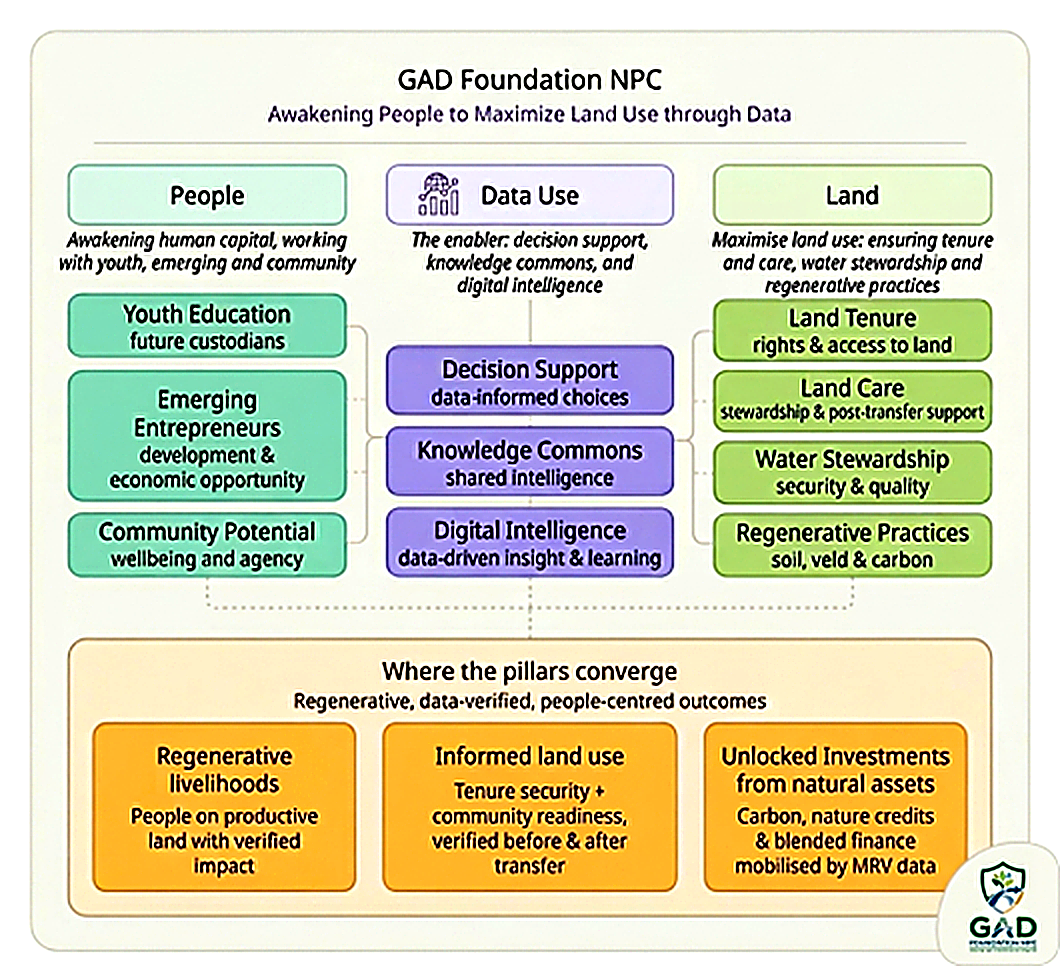
Our model begins with three interconnected pillars. Together they create the conditions for regenerative livelihoods, informed land use, and investable natural assets.
Implementation system
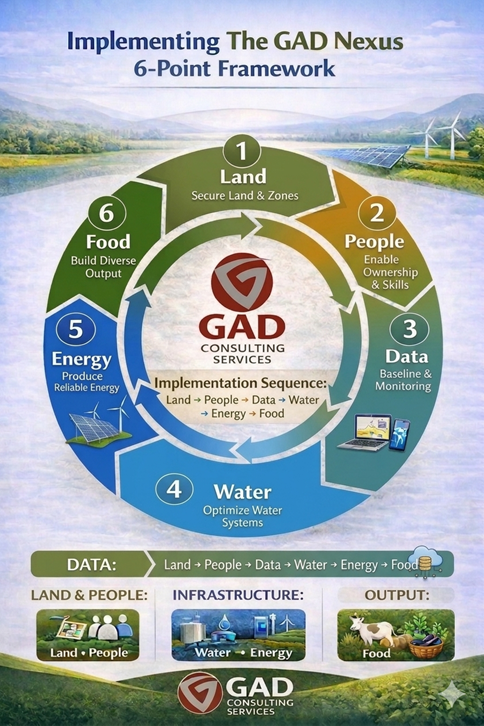
The Nexus expands the core model into six practical workstreams — connecting people, land, water, energy, food, and data into a complete delivery system.
From instability to readiness
The GAD model does not start with capital. It starts with readiness. Only once governance, systems, and evidence improve can partnership and investment become responsible.
Understand the community, governance, land, water, data, and readiness realities.
Strengthen governance, clarify rights, reduce conflict, and create the base for action.
Develop capability, stewardship systems, enterprise pathways, and verified data.
Present prepared opportunities to mines, DFIs, government, and responsible partners.
How it works in practice
Each programme expresses one part of the same operating model: people, land, and data working together.
The people layer: restoring dignity, mindset, agency, entrepreneurship, and local leadership capacity.
The land layer: governance recovery, land productivity, stewardship, and commercial readiness.
The intelligence layer: verification, dashboards, MRV, reporting, scorecards, and evidence-based decision support.
Bridge to capital
The GAD model creates the conditions that allow responsible capital to engage: governance, verified systems, credible partners, practical implementation, and measurable outcomes.
Better governance, clearer records, stronger systems, and verified readiness reduce early-stage project risk.
Land, water, data, food, energy, and people systems become organised into investable pathways.
Mines, DFIs, government, funders, and communities can engage through a structured and accountable model.
Next step
See how the model becomes practical through programmes, long-term strategy, and partnership pathways.